-01.svg)


n 12 August 2026, millions of people across Europe, Greenland, Iceland, and Spain will gather to witness one of nature's rarest alignments: a total solar eclipse.
While skywatchers on the ground raise their eclipse glasses, those of us working in space technologies will be watching in the opposite direction. From Low Earth Orbit, a solar eclipse isn't a blackout. It's a vast, dark shadow racing across the face of the planet at thousands of kilometres per hour.
Here is a guide to what a total solar eclipse actually is, how it forms, and how space technology helps us observe and interpret these events.
How Does a Solar Eclipse Work?
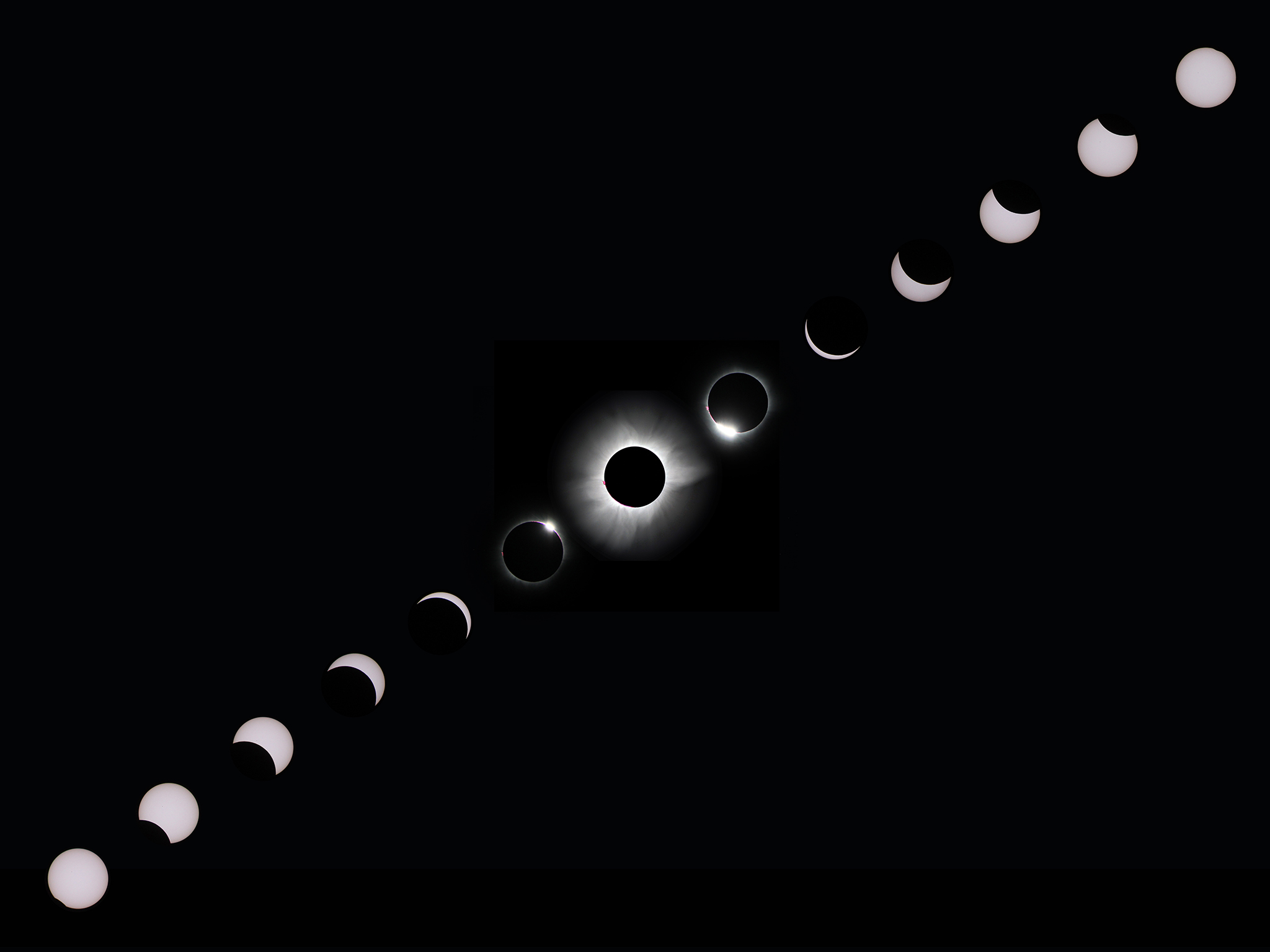
A solar eclipse occurs when the Moon passes directly between the Earth and the Sun, briefly blocking sunlight from reaching parts of the Earth's surface.
The Sun is roughly 400 times larger in diameter than the Moon, yet also about 400 times further away. This coincidence of scale and distance allows the Moon to align almost exactly with the solar disc during totality, unveiling the Sun's outer atmosphere, the corona, which is normally lost in the glare.
As the Moon aligns between Earth and Sun, it casts two distinct regions of shadow onto the planet:
- The Umbra: The dark central cone of the shadow. Anyone standing within it experiences the Sun fully hidden, with daylight dimming to a brief twilight. This is totality.
- The Penumbra: The broader, lighter outer region, where the Sun is only partly obscured and observers see a partial eclipse instead.
The 12 August 2026 Event: The path of totality begins over Arctic Russia, sweeps across Greenland, Iceland, and the Atlantic, then makes landfall across mainland Spain before fading near sunset over the Balearic Islands. It will be the first total solar eclipse visible from mainland Europe since 1999, a genuinely rare occurrence for the continent.
What Does an Eclipse Look Like from Space?
Aboard an Earth Observation satellite orbiting at around 500 km, you wouldn't see the Sun vanish at all. Instead, you would watch a distinct, circular shadow, resembling a dark inkblot, sweep across oceans and continents below.
Travelling at roughly 7.6 km/s (around 27,000 km/h), a satellite crosses the eclipse track in a matter of seconds. Brief as that window is, the data gathered during it carries real operational and scientific value:
- Satellites record how quickly ground and atmospheric temperatures fall as the umbral shadow passes overhead, data that feeds directly into climate and atmospheric modelling.
- The sudden collapse in ambient light offers a rare, naturally occurring test for automated exposure algorithms and onboard camera optics.
- Missions carrying specialised instruments, such as ESA's Solar Orbiter and Proba-3, use hardware blocking mechanisms to create artificial eclipses, allowing them to study the solar corona, solar wind, and radiation that can disrupt satellite communications on Earth.
How to Watch Safely from the Ground
Anyone planning to experience the eclipse in person should treat eye protection as non-negotiable. Looking directly at the Sun, even when largely covered, can cause permanent damage to the retina.
- Use Certified Eclipse Glasses: Ordinary sunglasses, however dark or polarised, offer no meaningful protection. Only specialised solar viewing glasses meeting the ISO 12312-2 safety standard are suitable.
- Inspect Before Use: Examine your glasses before looking skyward. Scratched, creased, or punctured lenses should be discarded without exception.
- Keep Them On: Glasses must remain on throughout every partial phase. The single exception is totality itself, the brief window when the Moon fully conceals the Sun and the naked eye is safe. The moment the Sun begins to reappear, glasses go straight back on.
- Mind Unfiltered Cameras and Binoculars: Never view the Sun through a camera lens, telescope, or binoculars while wearing eclipse glasses. Concentrated sunlight can burn straight through the filter, causing instant and irreversible eye damage.
Moments like the 2026 eclipse are a useful reminder of just how tightly our planet is bound to the wider space ecosystem around it. Through platforms like DataCosmos and shared satellite constellations, we put Earth observation data directly into the hands of the people who can act on it.
Whether you're watching from Spain or following the shadow's progress from orbit, it is a rare chance to look up and appreciate how much of what happens above us shapes life down here.