-01.svg)


pen Cosmos today presented its ambitious new plan to further expand its presence in Greece. The announcement comes less than a month after the company closed a new €300 million funding round, and three months after the successful launch of Hyperion GR-1, the first of seven satellites it is developing under the National Microsatellite Programme.
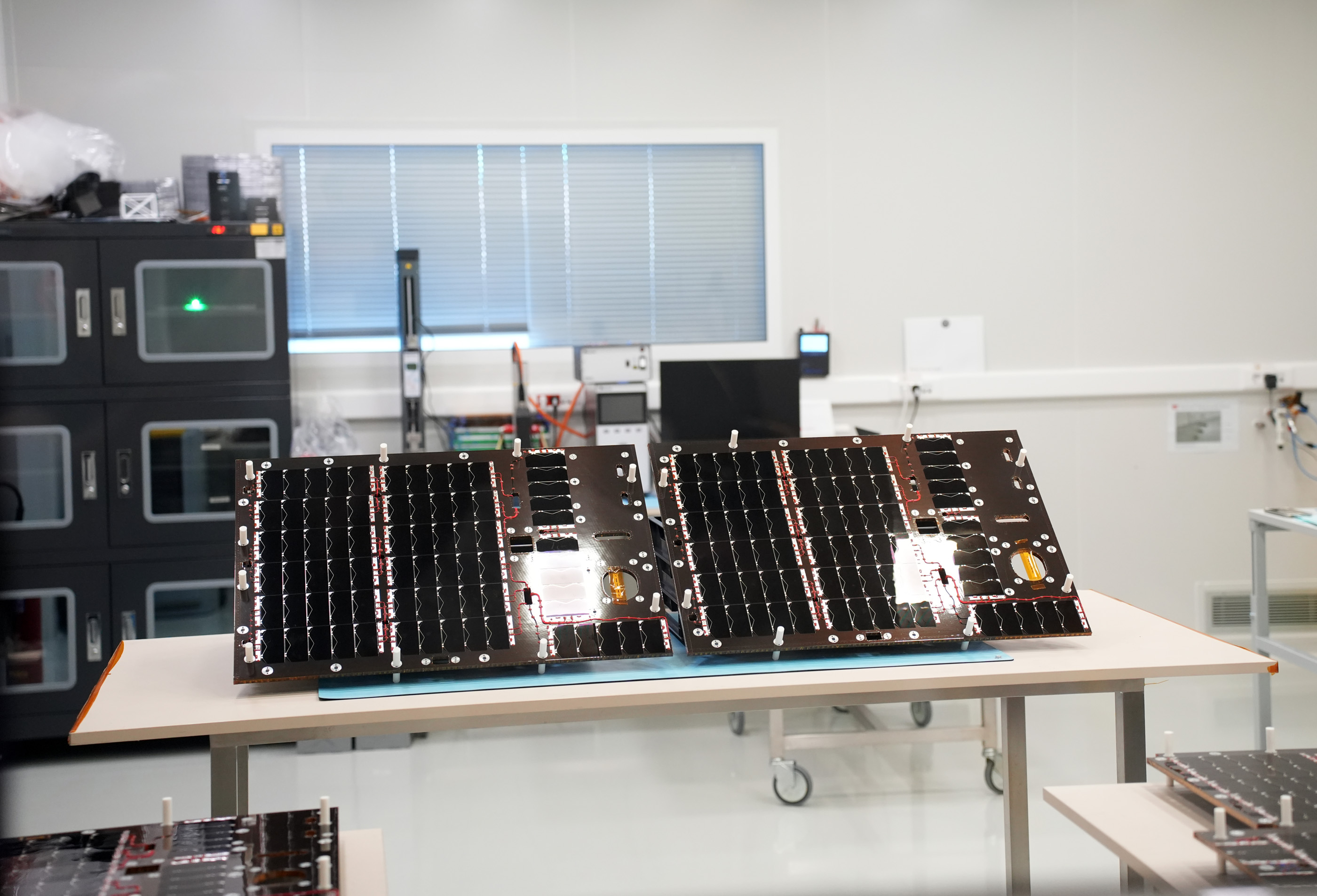
At an event in Athens, Open Cosmos announced plans to increase its Greek workforce eightfold by 2030. The plan also includes a significant expansion of its facilities, with new production sites that will substantially increase satellite production capacity in the country, as well as new office space.
The plan is part of Open Cosmos’s wider European strategy to expand its overall capacity for mass satellite production and to accelerate the development and delivery of its services through OpenOrbit, ConnectedCosmos, OpenConstellation and DataCosmos. These products cover end-to-end satellite missions, secure connectivity, Earth Observation and actionable data. The company currently has four production bases in Europe, one of them in Greece, and the new funding will further strengthen its engineering, production and software teams in the country.
The new funding round included two Greek investors, Sustainable Forward Capital (SFC) and Ireon Ventures, as well as international investors with strong ties to the Greek innovation ecosystem, such as the Environmental Technologies Fund (ETF Partners) and the Endeavor Catalyst Fund. Their participation further strengthens the link between Open Cosmos’s international growth and the Greek investment and business ecosystem.
From the Hyperion GR constellation to building complete space infrastructure in Greece
The new growth plan builds on the strong presence Open Cosmos has already established in Greece. In July, Hyperion GR-1 was successfully launched. It is the first of the seven satellites Open Cosmos Aegean is developing for the National Microsatellite Programme, and also one of the two satellites that started the deployment of the new OpenConstellation 1.0. At Thursday’s event, the first images from Hyperion GR-1 in its final orbit were shown publicly for the first time. The remaining six satellites of the Greek programme are either ready for launch or in the final stages of assembly.
Greece as a European hub for satellite missions
According to Open Cosmos Aegean’s plans, the goal of the further investment is to substantially strengthen its Greek operation as a full end-to-end satellite mission hub, covering design, manufacturing and integration through to satellite operations and use of the data. Earth Observation will remain a core pillar of the business, with a parallel focus on developing artificial intelligence and onboard data processing capabilities.
Over a three-year horizon, the company plans to significantly increase the number of missions delivered from Greece, in both Earth Observation and telecommunications. It will continue to use its Greek base to serve international markets, with a focus on Europe, Central Asia and the Middle East, among others.
This growth already has a strong export character. The Open Cosmos Aegean team in Pallini is developing technology not only for Greek missions but also for international customers, and contributes significantly to the design and subsystems of ConnectedCosmos, the company’s low Earth orbit telecommunications infrastructure.
It was recently announced that the ConnectedCosmos constellation will have a core of 192 satellites, with more than 96 expected to be in orbit by the end of 2028. Its deployment is central to Open Cosmos’s strategy to strengthen secure and resilient space connectivity in Europe and to link it with the company’s Earth Observation and IoT capabilities.
Growth in synergy with the Greek and European ecosystem
Open Cosmos continues to invest in a production and facilities model that emphasises close integration with the Greek space ecosystem. This model has proven highly successful, as shown at the company’s existing facilities, where subsystems are produced with ELFON and Adamant Composites.
The expansion of Open Cosmos’s facilities does not change the partnership strategy the company has consistently followed in Greece, with 13 Greek companies taking part in the current programme. Instead, it creates new opportunities to further strengthen the domestic industrial base and develop joint high-value projects. By deepening synergies with Hellenic Aerospace Industry, Greek companies, research centres, universities and other technology partners, Open Cosmos aims to help strengthen Greece’s space capabilities. It also aims to act as a catalyst, helping international partners who wish to establish activities in Greece.
Maria Kalama, Managing Director of Open Cosmos Aegean, said:
“In a very short time, we went from founding the company from scratch to creating a real production and technology base in Greece, building 7 satellites and launching the first Greek one, and operating critical space infrastructure.
Now we are moving into the next phase. By growing our team eightfold by 2030 and significantly increasing our production capacity, we are strengthening our ability to design, build and support complete satellite missions from Greece. We are creating more highly skilled jobs, developing know-how that stays here, and investing in production and technology capabilities that strengthen Greece’s strategic autonomy and international presence in the space sector. We are proud to be making a real contribution to Greece becoming a major European hub for space technology and services, with a strong export presence and the ability to develop and offer its own know-how and technology internationally.”
Rafel Jordà Siquier, Founder & CEO of Open Cosmos, said:
"Greece is an important part of Open Cosmos’s industrial base. In two years, we built the know-how, infrastructure and team needed to develop complete satellite missions in Greece, proving in practice what can be achieved when we invest in permanent production capabilities and highly skilled people.
The next step is scale. With new facilities, industrial mass production and a team that will keep growing quickly, we want Greece to play an even bigger role in Open Cosmos’s European network and to serve missions and customers well beyond Greece’s borders. The recent €300 million funding allows us to accelerate this strategy and strengthen a truly European space industry, with strong national bases that work together and can give Europe greater autonomy, resilience and technological sovereignty.”
Dimitris Papastergiou, Minister of Digital Governance and Artificial Intelligence, said:
“Open Cosmos is part of a much bigger change that has been taking place in the Greek space sector in recent years. With clear political will from Prime Minister Kyriakos Mitsotakis to develop the space sector, we are investing in infrastructure, technology and, above all, in the people who can keep Greece at the forefront of developments. What is especially valuable is that we now see young scientists finding opportunities here, companies growing, and Greek know-how gaining an international presence. Space already has a very concrete footprint in our daily lives, from communications and security to civil protection. And Greece now has the capabilities to take part not as a spectator, but as an active player.”