-01.svg)


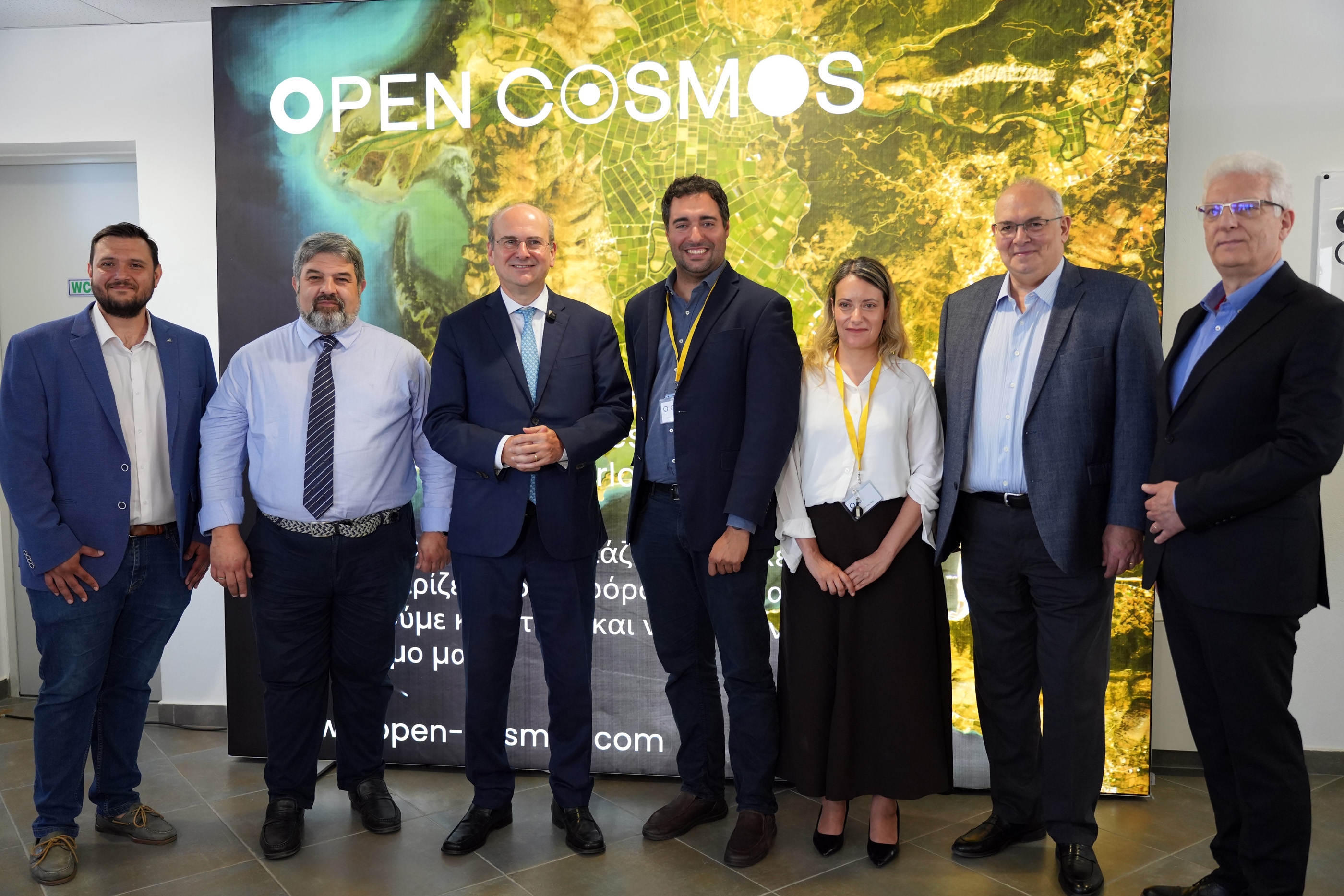
eputy Prime Minister of Greece Kostis Hatzidakis visited Open Cosmos Aegean’s satellite manufacturing facilities in Pallini, where he was briefed on the company’s work under the National Microsatellites Programme, its growing export activity from Greece, and its plans for further growth in the country.
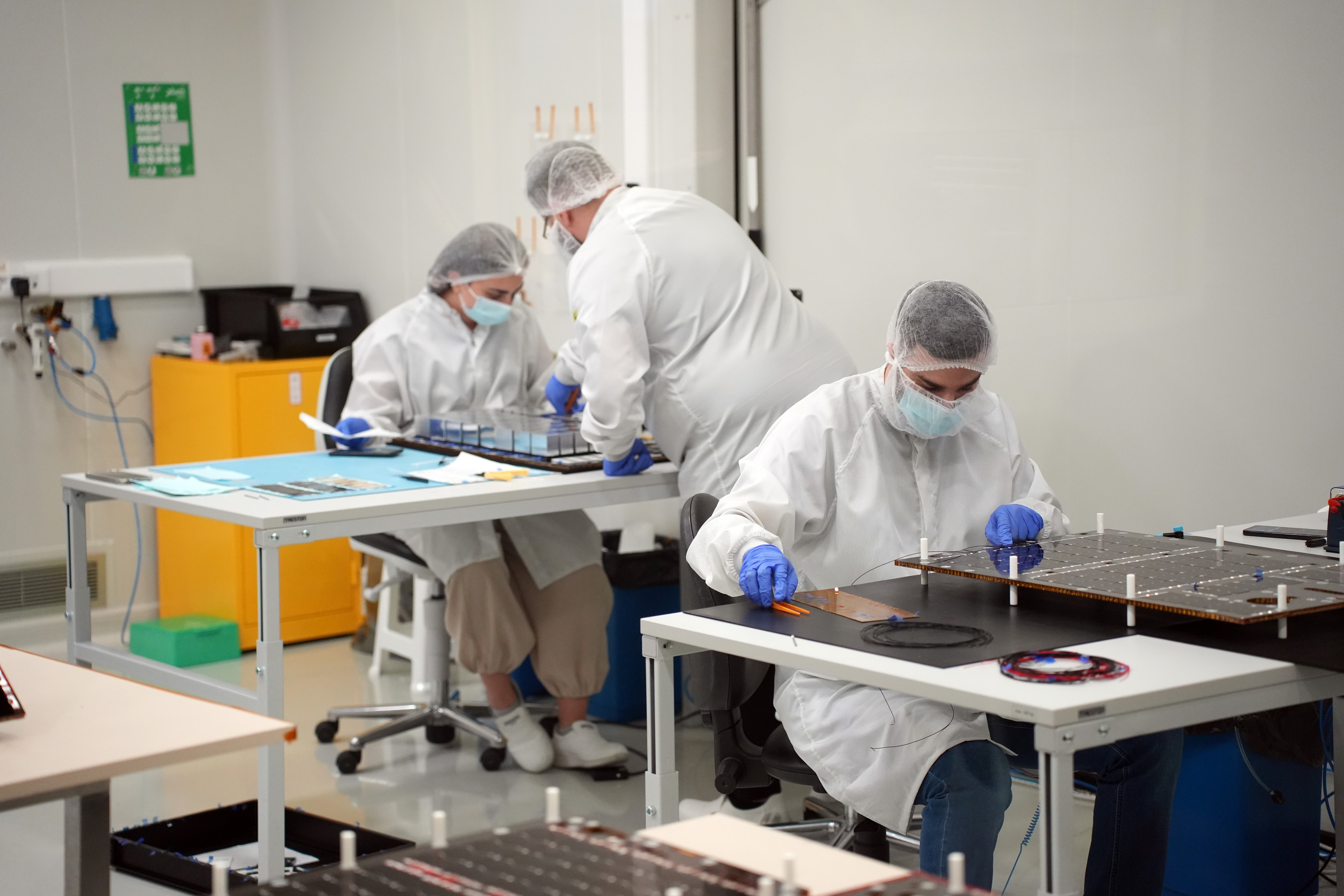
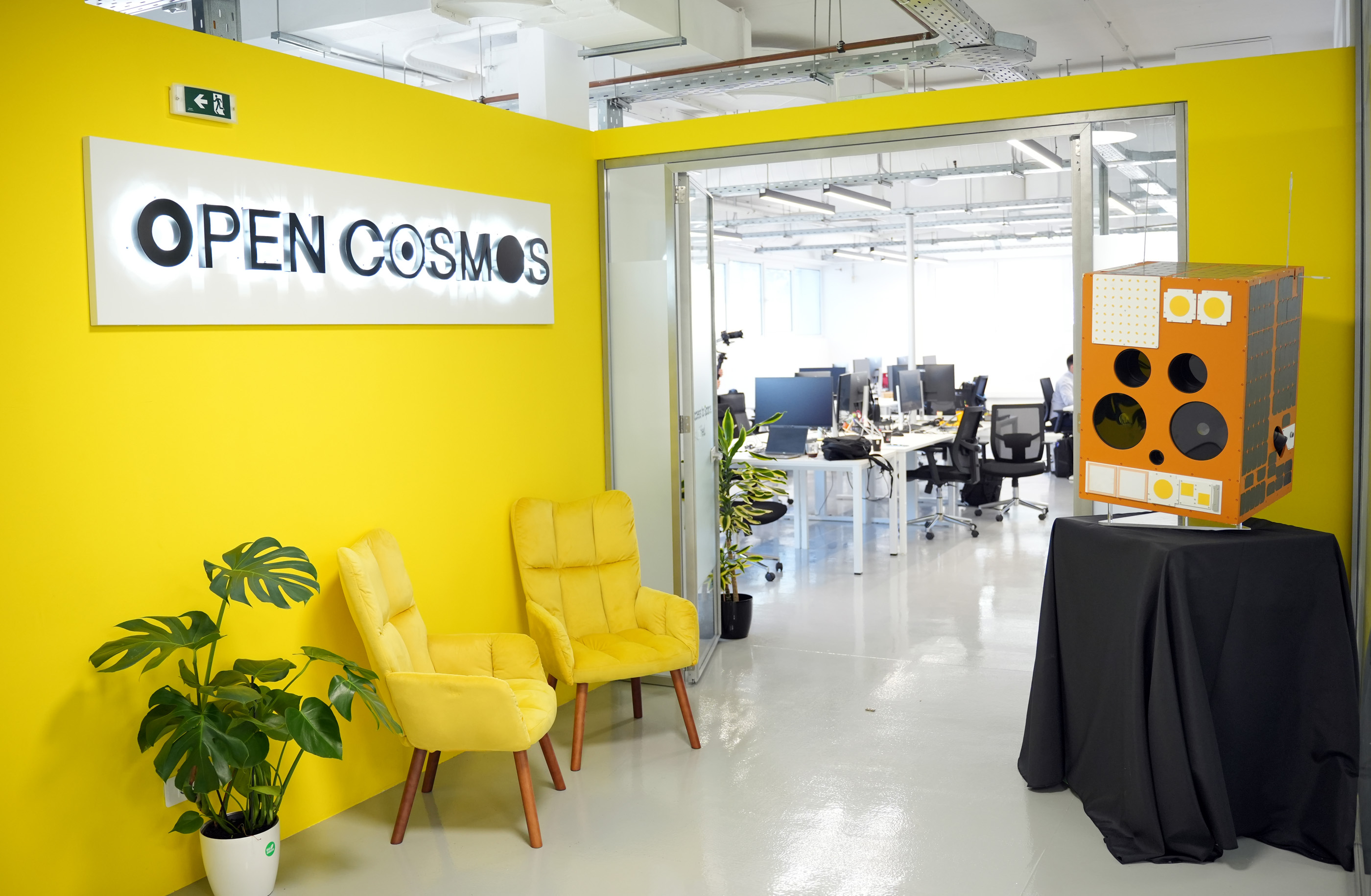
Mr Hatzidakis toured Open Cosmos Aegean’s satellite production and testing areas, as well as its satellite data reception infrastructure. He also met with the company’s leadership to discuss the project’s strategic importance for Greece’s national capabilities, technological autonomy and the export-oriented growth of the Greek space ecosystem.
The Greek Deputy Prime Minister Kostis Hatzidakis said:
“What is happening here is impressive not simply because it relates to space and Greek satellites. Above all, it is extremely useful for our economy, for our agriculture, for transport, for the country’s defence, and for strengthening Greece’s international standing.
As we enter this new era, it is very important for countries to have a presence in space policy. Open Cosmos is a highly dynamic company in this field, and we, as the Government, have every reason to support efforts of this kind, especially since they are driven by young people, including young Greeks who have returned from abroad to work here”.
The programme will enter its launch phase in July with the first satellite, Hyperion GR1, together with the commissioning of the Greek ground station, which has already been installed. The 100 kg-class satellite will provide 90 cm-resolution imagery in the panchromatic band and will be equipped with powerful onboard AI analytics capabilities and inter-satellite links.
In total, Open Cosmos Aegean is delivering the largest part of the National Microsatellites Programme, building seven of the programme’s 13 satellites in Greece, together with a ground station. The Hyperion GR constellation will combine advanced Earth Observation and connectivity capabilities: two microsatellites equipped with very high-resolution cameras for sub-metre imagery, and five microsatellites carrying multispectral and hyperspectral imaging systems, Short-Wave Infrared (SWIR) imaging capabilities, Internet of Things receivers and Automatic Identification System (AIS) receivers. All seven satellites will also include inter-satellite links and onboard AI capabilities, enabling the faster collection, processing and transmission of critical data from space to Earth.
Through Open Cosmos’ investment in state-of-the-art infrastructure, cutting-edge technology and highly specialised talent, Greece is strengthening its capability to design, manufacture, test and operate space systems in critical areas such as Earth Observation and telecommunications.
The name Hyperion / Hyperion GR, together with the mission patch, was chosen through a school competition coordinated by the Ministry of Digital Governance, the Ministry of Education, Religious Affairs and Sports, and the Hellenic Space Center. The initiative brought the project closer to the younger generation and reflected the vision of a Greece that is not only using space technology, but actively contributing to its development. Evoking light, observation and knowledge, the name Hyperion captures the purpose of the satellites: to collect and deliver high-precision data for the benefit of society, the economy and the environment.
The satellites being built in Pallini will support critical applications for the public good, including the prevention and management of natural disasters, environmental monitoring, precision agriculture, maritime surveillance, urban planning and faster public-sector decision-making. At the same time, the know-how developed through the Greek programme is helping position Greece as an export hub for space infrastructure, technology and data services for the wider region.
Rafel Jordà Siquier, Founder and CEO of Open Cosmos, said:
“Open Cosmos Aegean is building satellites and developing technology not only for Greece, but for customers and missions around the world. From Pallini, our team is also contributing subsystems to ConnectedCosmos, our new constellation, further strengthening Greece’s role in the European and global space value chain.
Greece is now one of Open Cosmos’ four European production bases. We will continue to invest in the country, work with its exceptional talent, and build cutting-edge, export-oriented space technology that supports national capabilities and serves international markets.”
Maria Kalama, Managing Director of Open Cosmos Aegean, said:
“We are grateful to Deputy Prime Minister Kostis Hatzidakis for visiting our facilities today, for his valuable insights , and for his personal interest in our work. We also thank the Greek Government, and in particular the Ministry of Digital Governance and the Hellenic Space Center, for the strong momentum they have given to the Greek space industry through the National Microsatellites Programme.
At Open Cosmos, we are especially proud that this programme brings together an entire ecosystem: more than 13 Greek companies, research organisations such as the National Observatory of Athens, and investors such as the Hellenic Development Bank of Investments and Ireon VC. The enthusiasm around the choice of the name Hyperion and the design of the mission patch shows how strongly a project like this can inspire the younger generation.
This is clear proof that Greece can design, build and export cutting-edge technology, for the benefit of Europe, the national economy, public administration and society.”
The Greek satellites will become part of OpenConstellation, Open Cosmos’ collaborative satellite infrastructure, currently comprising 23 satellites, which enables governments, research institutions and businesses to access satellite data and services more efficiently and more cost-effectively. Through this model, Greece is not only acquiring its own satellites but also becoming part of a wider European infrastructure that secures faster access to critical data, resilience and technological autonomy.
Open Cosmos Aegean currently employs around 30 engineers and space technology specialists, many of whom have returned to Greece or chosen to work in the country after gaining international experience. The growth of this team is part of a broader effort to establish Greece as a stable, export-oriented space technology hub, capable of supporting both national projects and international commercial activity.